
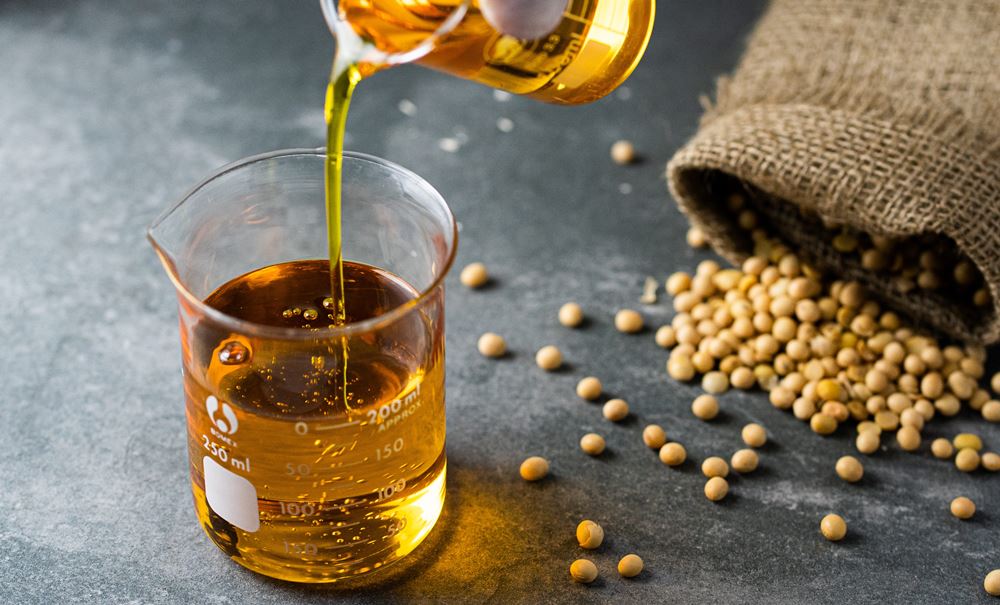
Soybean oil leaves a Brazilian crushing plant in one of two commercial states: crude degummed (CDSO), an intermediate product destined for further refining, or fully refined (RBD — refined, bleached, deodorised), ready for food use. Importers regularly ask which to buy. The answer depends on what happens to the oil after it arrives.
What degumming does — and doesn't — remove
Degumming washes phospholipids ("gums"), mucilage and heat-unstable impurities out of crude oil. The result is a stable, transportable oil with phosphorus typically below 200 ppm and free fatty acids below 1.5%. It still carries colour, flavour compounds and trace impurities — it is not edible as-is. Refining at destination then neutralises, bleaches and deodorises it into food-grade oil.
Side-by-side comparison
| Attribute | Degummed (CDSO) | Refined (RBD) |
|---|---|---|
| State | Intermediate, needs refining | Finished, food grade |
| Typical FFA | ≤ 1.5% | ≤ 0.1% |
| Phosphorus | ≤ 200 ppm | Trace |
| Colour & taste | Amber, raw flavour | Light, neutral |
| Price level | Lower | Higher (refining margin included) |
| Shelf life | 12–24 months | 18–24 months |
| Typical shipment | Bulk tanker, flexitank | Flexitank, drums, IBC, retail packs |
Choose CDSO if…
- You operate a refinery or toll-refine locally — you capture the refining margin and can tune the final product to your market.
- You produce biodiesel — FAME plants prefer degummed oil; full refining adds cost without benefit, and low phosphorus protects catalysts.
- You buy large volumes — bulk tanker freight per ton is significantly cheaper than containerised refined oil.
Choose refined oil if…
- You bottle or distribute cooking oil without refining capacity — flexitank shipments feed local bottling lines directly.
- You manufacture food — fried snacks, baked goods, sauces and margarine need neutral, fully refined oil with verified peroxide and colour values.
- You want private-label retail product — we pack 1–20 L formats under buyer brands, which no crude grade allows.
Quality parameters to fix in the contract
For CDSO: FFA, moisture and impurities, phosphorus, flash point and colour. For refined oil: FFA, peroxide value, colour (Lovibond), moisture, and cold test where relevant. In both cases make the independent surveyor's certificate at loading final for weight and quality — it is the international norm and avoids destination disputes.
Talk through your case
Unsure which grade fits your operation? Outline your end use in the enquiry form and our trade desk will recommend a grade and quote both ways. See the full specifications on our degummed soybean oil and refined soybean oil product pages.
Frequently asked questions
Can degummed soybean oil be used directly for cooking?
No. CDSO is an intermediate grade that must be refined (neutralised, bleached, deodorised) before food use.
Why is degummed oil cheaper than refined?
The price difference reflects the refining margin — processing cost plus the refiner's return. Buying CDSO lets refiners capture that margin.
Which grade is better for biodiesel?
Degummed. Biodiesel plants need low phosphorus but not food-grade refinement, so CDSO offers the right spec at the lower price.
Further reading
How to import soybean meal from Brazil →Brazilian soybean oil exports: key markets and how to buy →Shipping agricultural cargo from Brazil: ports, Incoterms and documents →Source it from the producer
Specifications, volume, destination — we quote within one business day.